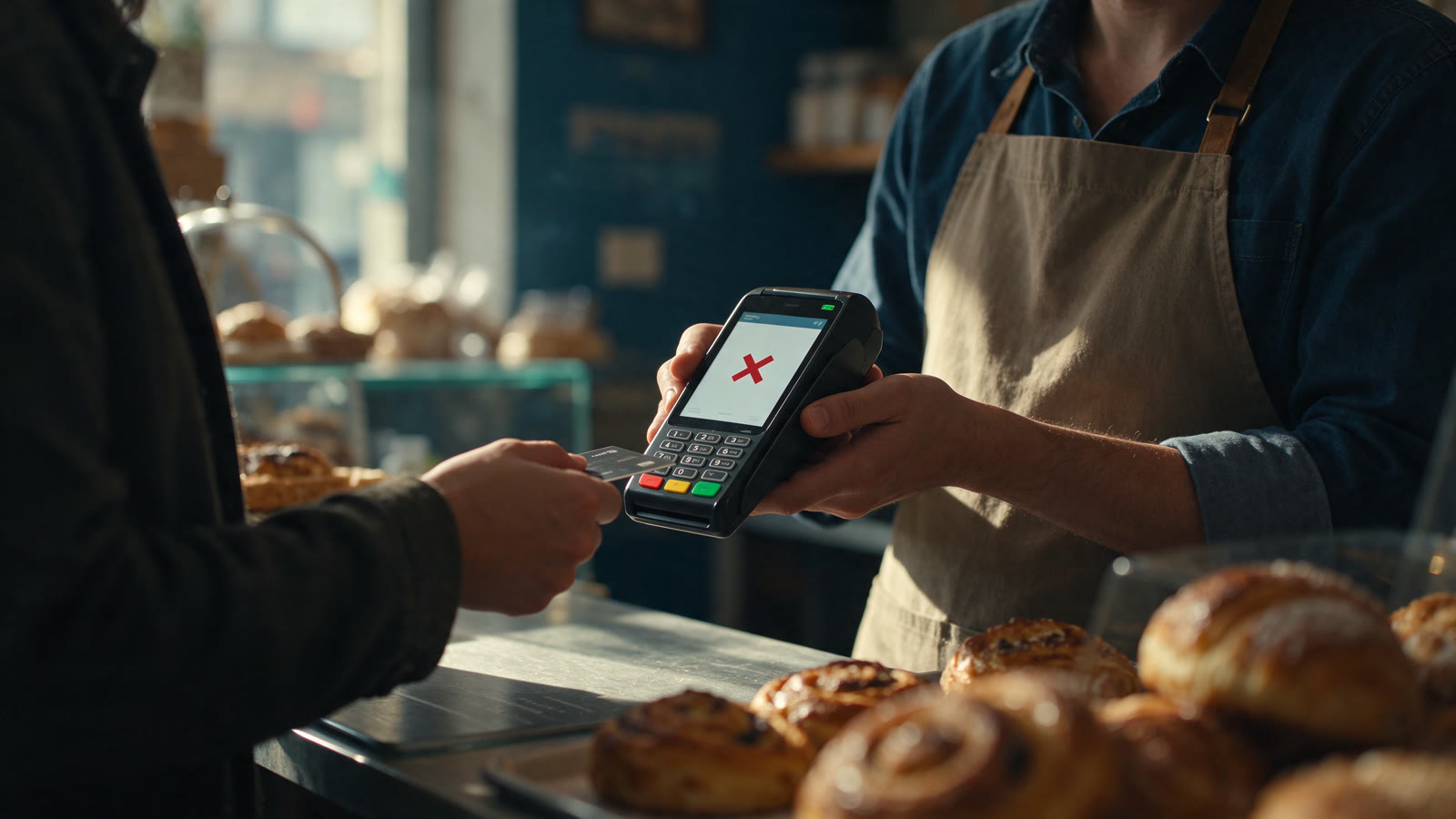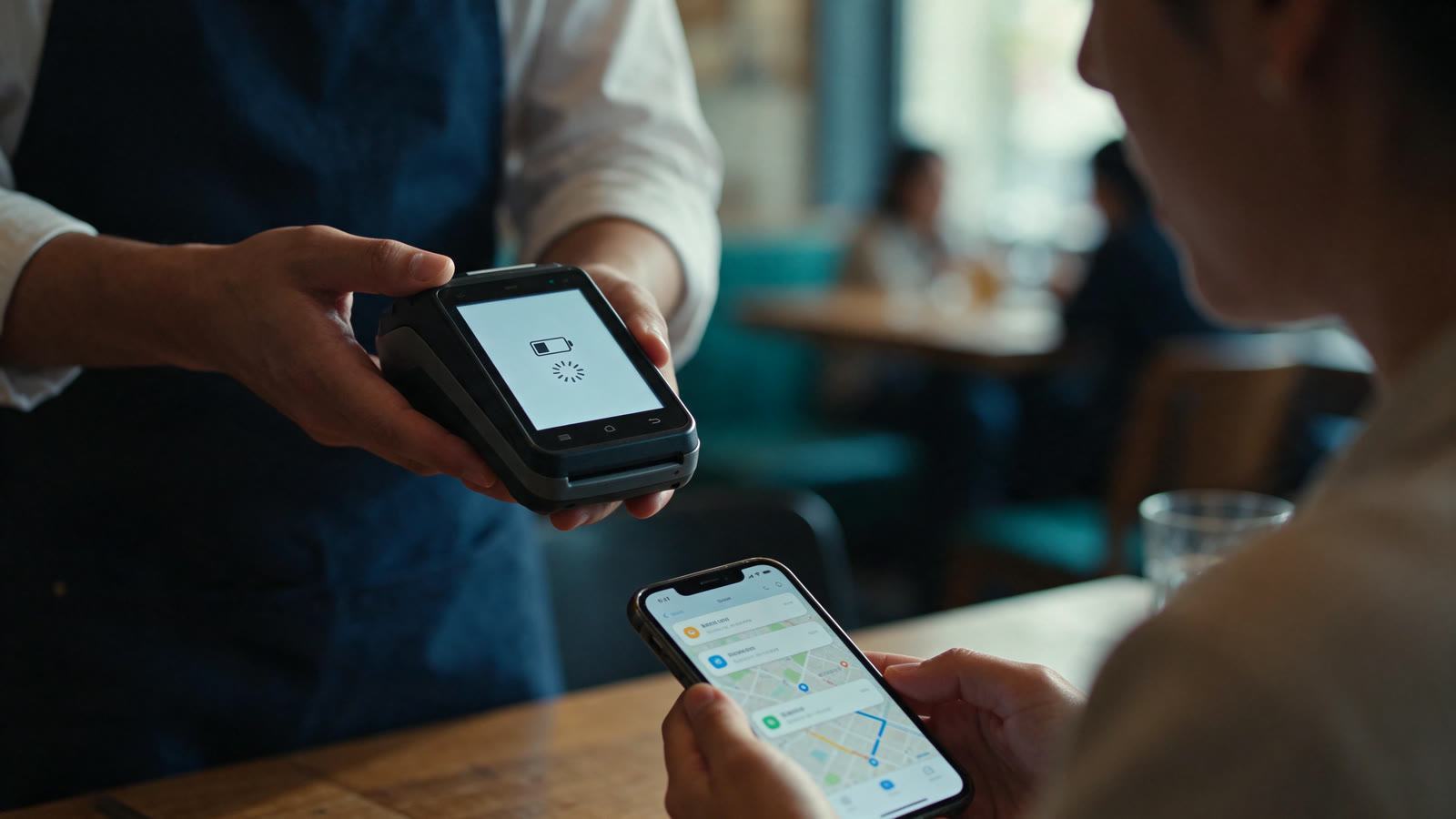
A handheld with a worn battery browns out during a contactless tap, after the authorisation is sent but before the response is saved. It reboots with no record of the payment. The partner point of sale sees a timeout and retries without an idempotency key, and the card is authorised again. Every component logs a normal sale; the customer sees two.
- The failure is a chain: a battery, an app update and a retry rule. No single team owns all three.
- The evidence lines up to the second: a voltage dip, a reboot, then a second authorisation for the same token and amount.
- Idempotency on the retry is the partner fix. The device and app fixes stop the reboot in the first place.
Three ordinary things that add up to one bad one
An app update starts sending digital receipts over the cellular radio during the transaction rather than after it. On most devices that is harmless. On an older hardware revision with batteries well past their best, the extra radio load during a contactless tap is enough to dip the voltage and trigger a brownout reboot.
The timing is what makes it expensive. The reboot lands after the authorisation request has gone out but before the response is written to storage. When the device comes back, it has no record of the payment. The partner point of sale driving it sees a timeout and does what its retry rule says: it sends the sale again. The card is authorised a second time.
Why it looks normal everywhere
- Device health shows an occasional reboot with reason “brownout”, which happens on any fleet of ageing handhelds.
- Approval rates are normal. Both authorisations were approved.
- The partner point of sale logged a timeout and a successful retry, which is its retry logic working as designed.
- The support AI agent, asked about a customer charged twice, explains how to void a payment. The instruction is correct, so the conversation closes well.
- Disputes rise gradually, a few weeks behind the duplicates, and are worked one at a time.
The void macro gets used far more often than it used to. That is the closest thing to an alarm, and it reads as a training issue rather than a defect.
The evidence lines up to the second
The clearest way to see this failure is a three-lane timeline for one sale:
- Battery voltage from device telemetry, dipping during the tap.
- Device events: the reboot, with reason brownout, within a couple of seconds of the tap.
- Authorisations: two for the same card token, amount and merchant within a couple of minutes, where the first has no device record.
Put the three lanes next to each other and the chain is obvious. Look at any one of them alone and it is noise. Add the partner's “timeout, retrying sale” entries and the dispute files, and the duplicate pairs turn out to share one device cohort: one hardware revision, one battery band, one app version.
Payments engineers will ask why the retry did not carry an idempotency key. It is the right question. A retry that queries payment status first, or sends a key the processor can deduplicate on, turns a double charge into a harmless repeat. It is also the fix least likely to be made, because it belongs to a partner rather than to either team that caused the reboot.
Sizing it
The unit of loss is duplicate charges and the chargebacks they produce. For your own fleet:
- Count authorisation pairs with the same token, amount and merchant inside a short window, where the first has no device record.
- Split them into refunded and not yet refunded. The second group is money customers are still owed.
- Add the chargebacks those pairs produced, at the dispute fee plus the handling time each one takes.
- Count the devices in the affected cohort that have not failed yet. That is the exposure still ahead.
Why it comes back
Brownout clusters are not new on any fleet with batteries. A previous one, perhaps after a charging-dock firmware update, was most likely solved with a battery replacement programme. The batteries were swapped and the incident closed, but nobody added a check for duplicate authorisations following a reboot. The next change that raised power draw found the same gap, and the earlier programme is the evidence that this is a pattern rather than bad luck.
What fixes it, and who owns each part
- Payments app team: defer receipt radio use until the authorisation response is saved.
- Device hardware team: replace batteries in the affected cohort before they fail.
- Partner integrations: an advisory asking partners to query payment status, or send an idempotency key, before any retry. See retries and idempotency for why this matters well beyond payments.
- Merchant support: a refund list of outstanding duplicates, so customers are made whole without having to dispute.
- Support AI agent: an eval case its release must pass. Before giving void instructions, it checks for a reboot during the first authorisation and flags the device cohort.
Where Traxivo fits
Traxivo reads device telemetry, authorisation logs, partner logs, disputes and support conversations through read-only connections, with nothing installed on the devices. It links them into one issue, recognises the earlier brownout cluster as the same pattern, names the three owners, and drafts the refund list and partner advisory for a named approver. Double charges are one of the failure patterns behind Traxivo for Payments. For the same pattern in other industries, see solutions by industry.
The ten use cases on the Traxivo for Payments page are the ones most payments and commerce estates share. Your niche will have failures of its own. We build custom solutions for those on top of the same platform: connectors for the feeds only your niche has, detection for the pattern only your estate shows, and the loss counted in your own unit. The same approach extends to niches such as stored-value and gift card programmes, fuel forecourts and unattended kiosks, restaurant and hospitality point of sale and marketplaces paying out sellers.
Sources
- Javelin Strategy & Research, reported by a chargeback vendor. What Mastercard’s Chargeback Research Can Tell Us About Improving the Dispute Process, 2026.
- Datos Insights, cited by a chargeback vendor. What Mastercard’s Chargeback Research Can Tell Us About Improving the Dispute Process, 2026.
- LexisNexis Risk Solutions. Retail and Ecommerce Companies Face More Than $5 in Costs for Every $1 Lost to Fraud Amid Rising Complexity and Customer Experience Pressures, 2026.
Every figure on this page comes from the published source it is linked to and describes the industry at large. None is a Traxivo or customer result.
Frequently asked questions
Why do device reboots cause duplicate card charges?
If a device reboots after sending an authorisation but before saving the response, it loses its record of the payment. A point of sale that retries on timeout, without checking status or sending an idempotency key, then authorises the card a second time.
How do you find duplicate charges caused by hardware?
Look for pairs of authorisations with the same token, amount and merchant in a short window, where the first has no device record, and line them up with device reboot events and battery telemetry.
Is an idempotency key enough on its own?
It stops the second charge, which matters most to customers. It does not stop the reboots, which also interrupt sales and lose receipts, so the device and app fixes are still needed.
Stop rediscovering the same integration failure
Traxivo links the alerts, tickets and email threads your teams already produce into one history per issue, recognises when a fault returns, and drafts the follow-up with the evidence attached. Nothing is sent until a person approves it.
See how Traxivo works See Traxivo for Payments