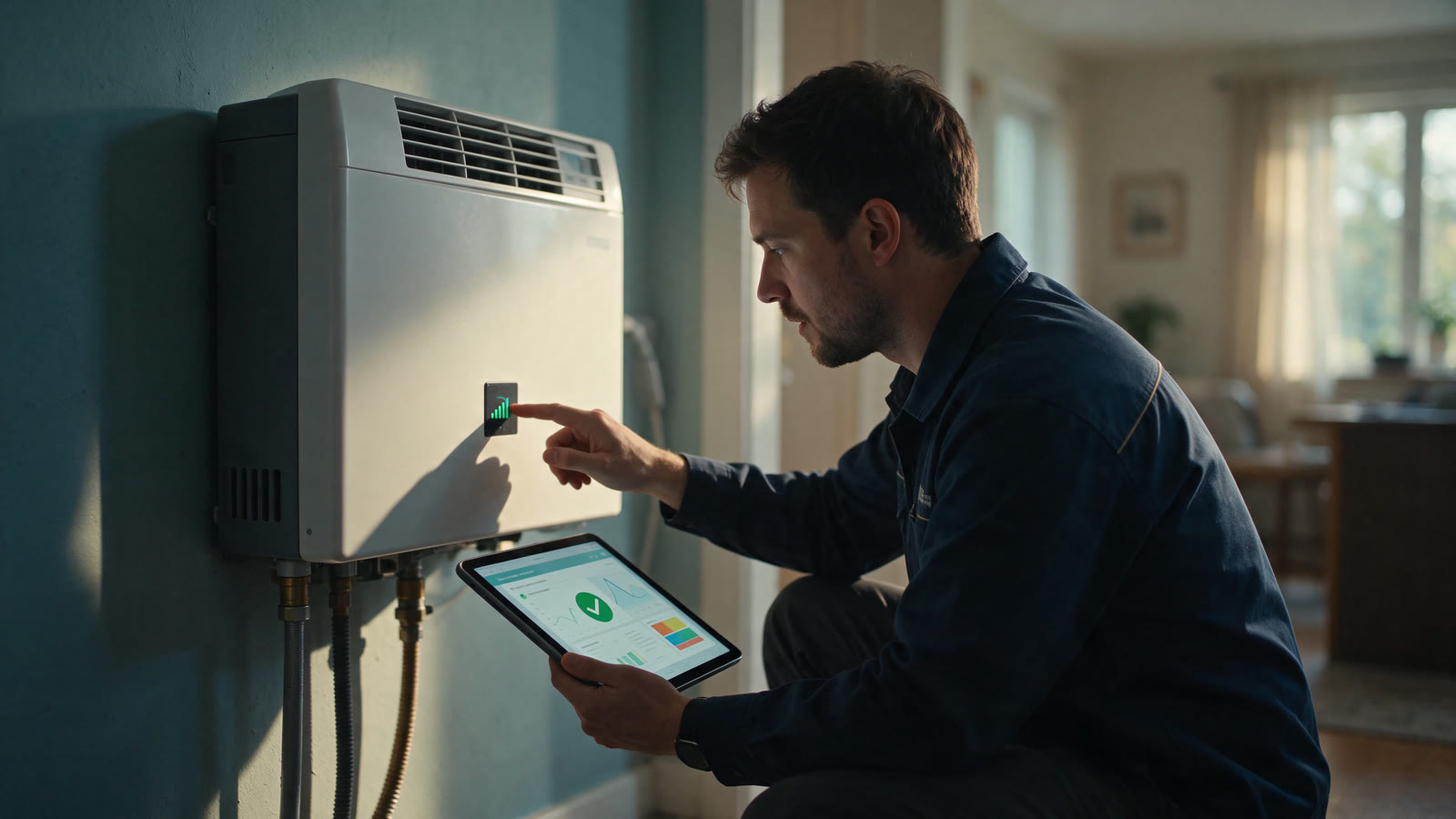
A predictive maintenance model can only score what it is sent. If one battery-powered vibration sensor model stops transmitting samples as its charge runs down, the gateway may still list it as online, and the model, with nothing new to score, leaves the asset at healthy. Nothing errors, because silence is not an error. The breakdown the programme was meant to predict arrives unannounced, on an asset the record shows as green.
- Healthy should mean measured and found well. A score with no recent samples behind it means nobody looked.
- The tell is sample rate grouped by sensor model and battery level. The online flag will not show it.
- Size it in unplanned failures on assets the programme said it was watching, using your own breakdown records.
A health score needs something to score
Predictive maintenance rests on a simple chain. Sensors on bearings, gearboxes and motors take vibration samples. A gateway collects them. A model scores each asset, and maintenance plans its work around the scores. The whole programme exists to turn unplanned equipment failures into planned ones.
An unplanned failure can still get through in two ways. The model can miss a fault it has data for. Or the data can stop, and nothing in the chain treats that as news. This post is about the second.
Suppose one model of battery-powered sensor is built to protect its last reserve of charge. Below a certain battery level it stops sending vibration samples and sends only an occasional short check-in. The gateway still knows the device, hears from it now and then, and shows it online. The maintenance model scored the asset healthy on its last real sample, and with no new sample to contradict that, healthy stands.
Why the screens stay green
- The gateway lists the sensor as online, because online means joined and recently heard from, not sending measurements.
- The maintenance model raises no anomaly. An anomaly needs a sample that looks wrong, and there are no samples.
- Battery level is reported, in a field on a device page that nobody trends.
- The maintenance system holds no work order for the asset, because nothing asked for one.
- Programme coverage is counted in sensors installed, which has not changed.
Each of these is accurate about its own part. The absence of an alarm reads as the absence of a problem.
The ordinary-looking tell
The evidence sits in records owned by different teams, and shows only when they are put side by side:
- samples received per sensor per day, grouped by sensor model and firmware
- battery level at each sensor's last report
- the age of the newest sample behind every current health score
- breakdowns and emergency work orders on assets that were scored healthy at the time
- technician notes from those repairs, such as “changed the battery while we were there”
Grouped by sensor model, one line on the chart falls away as battery level drops, while the other models keep sending until they are flat. Sensor by sensor, it looks like a few unrelated devices having a quiet week.
A health score is a claim about a machine at a moment. It should carry the age of the newest sample it rests on. A score with nothing behind it for weeks is a memory of a diagnosis, and it deserves its own state on the screen: not measured.
What it costs, and how to size it
The unit of loss is unplanned equipment failures on assets the programme was supposed to be watching. To size it for your own plant:
- List the breakdowns and emergency work orders on monitored assets over the past year.
- For each one, count the samples its sensors delivered in the weeks before the failure.
- Set aside the failures that followed a healthy score with few or no samples behind it. The programme never had a chance to predict those.
- Multiply by your own cost of an unplanned stop for that class of asset, less what the planned repair would have cost.
- Then count the assets scored healthy today on stale input. That is exposure that has not arrived yet.
The last number is the one that can still be changed.
Why it comes back
Batteries are a consumable, and sensors fitted in the same quarter run down in the same quarter. The first quiet sensor gets a new battery from a passing technician, the job is closed, and nothing about sample rates is added to anyone's report. Then the rest of that cohort reaches the same level. A later purchase adds a sensor model with different low-battery behaviour, and the gap reopens somewhere else.
What fixes it, and who owns each part
- Reliability engineering: every health score shows the age of its newest sample, and “not measured” is a state of its own, separate from healthy.
- The gateway owner: report and alert on samples received per sensor, not on whether the sensor is joined.
- Maintenance planning: battery replacement becomes planned work by installation cohort, ahead of the level at which that sensor model goes quiet.
- The sensor supplier: a dated request for the documented low-battery behaviour of each model and firmware version.
- The maintenance model's next release: an eval case it must pass. Given an asset with no samples in the scoring window, it returns not measured. Replayed against the quiet period, the current release returns healthy every time.
Where Traxivo fits
Traxivo stays read-only and outside control networks, and installs nothing on sensors or equipment. It reads the gateway telemetry, model inputs, work orders and failure records your systems already produce and links them into one issue with a history, so a quiet sensor model and the breakdowns behind it are one story. It recognises when the same failure returns with the next battery cohort, names the owners, and drafts the supplier request for a named person to approve. See quiet sensors among the industrial failure patterns, and the same shape in other industries.
The ten use cases on the Traxivo for Industrial page are the ones most manufacturing and industrial iot estates share. Your niche will have failures of its own. We build custom solutions for those on top of the same platform: connectors for the feeds only your niche has, detection for the pattern only your estate shows, and the loss counted in your own unit. The same approach extends to niches such as food and beverage batch plants, discrete assembly with vision inspection, temperature-controlled supply chains and connected equipment makers.
Sources
- Limble (press release carried by Manufacturing Dive). Limble Report Finds Maintenance Teams Struggling to Get Ahead of Downtime, 2026.
- MaintainX. AI Goes Mainstream on the Factory Floor, MaintainX Report Finds (2026 State of Industrial Maintenance report), 2026.
- Warranty Week. 23rd Annual Product Warranty Report, 2026.
Every figure on this page comes from the published source it is linked to and describes the industry at large. None is a Traxivo or customer result.
Frequently asked questions
How can a vibration sensor show online while sending no data?
Online can mean no more than that the gateway knows the sensor and has heard from it recently. A short check-in satisfies that. Whether the sensor is still delivering vibration samples is a separate question, answered by counting the samples received from each sensor.
Why does the maintenance model keep reporting healthy?
Because it reports the result of its last scoring, and with no new samples there is nothing to change that result. Unless the model or the screen in front of it tracks the age of its inputs, an unmeasured asset and a healthy one look the same.
Does Traxivo install anything on sensors or connect to controllers?
No. Traxivo stays read-only and outside control networks. It reads the telemetry, model inputs and work orders your systems already produce, and nothing is installed on sensors or equipment.
Stop rediscovering the same integration failure
Traxivo links the alerts, tickets and email threads your teams already produce into one history per issue, recognises when a fault returns, and drafts the follow-up with the evidence attached. Nothing is sent until a person approves it.
See how Traxivo works See Traxivo for Industrial