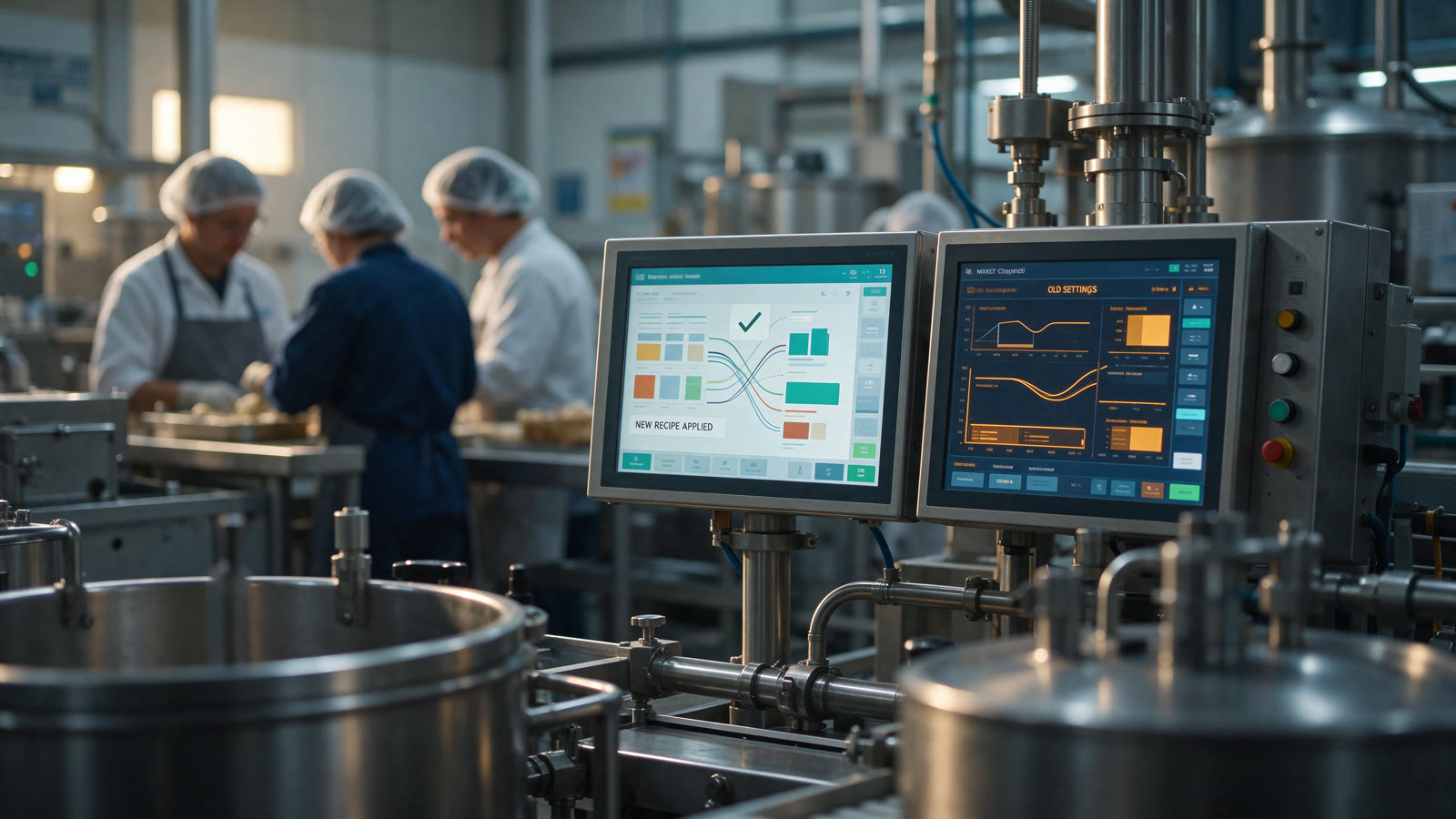
Recipe management records that a parameter set was sent. It does not, by itself, prove the controller is running it. If one line's controller refuses the new values, because of a local limit, a version difference or the state it was in, that line keeps producing on the old parameters while the recipe system shows applied everywhere. No alarm fires, since the line is running normally to a recipe it was meant to have left.
- Applied describes the sender. The receiver's answer is the readback, and it is recorded somewhere else.
- The tell is one line whose recorded parameters did not change on the day every other line's did.
- We know of no public benchmark for this failure, so size it from your own push records and readbacks.
Applied describes the sender
A recipe change in a batch plant is meant to be dull. Process engineering approves new parameters: a temperature, a hold time, a dosing quantity. Recipe management pushes them to every line that makes the product and records the push. From that moment the organisation believes the change is live.
The belief rests on one word. “Applied” in the recipe system can mean that the set was sent, that it was delivered, or that the controller accepted the values and is using them. Those are three different events, and only the last one changes the product.
Suppose one line's controller refuses the new set. A value falls outside a limit configured on that line. The controller runs a different program version with a slightly different parameter structure. Or the line was mid-batch and not in a state to accept a download. The controller behaves correctly by keeping what it has. The recipe system, having sent the set without an error it recognises, marks the line as applied. Production continues on the old parameters.
Why nothing objects
- Recipe management shows the new version applied to every line.
- The controller runs steadily. The old parameters were valid last week and they are still valid values.
- Alarms stay quiet, because the process sits inside limits that were set for the old recipe.
- The batch record names the new recipe version, because it takes the version from the recipe system.
- Quality sees results from one line sitting differently from the others, and looks first at raw material and operators.
Nothing is broken. A line is running well to a recipe it was supposed to have left.
Three records, compared line by line
The evidence is a comparison that takes minutes once the records are in one place:
- push records from recipe management: which parameters, which version, which lines, when
- the parameter values each controller holds, as the historian or gateway records them
- batch quality results by line, before and after the push
- any controller or gateway log entry for a refused or partial download
- shift notes such as “line three still on old hold time?”
On the lines that took the change, the recorded parameters step to the new values at the time of the push. On the line that refused it, they do not move at all. A value that should have changed and did not is the tell, and it can be seen without touching a controller.
Any system that sets a value somewhere else can report two things: that it sent the value, and that it later read the same value back. Only the second is evidence. If your recipe system's status does not say which of the two it means, treat it as the first.
What it costs, and how to size it
The unit of loss is off-spec batches. We know of no public benchmark for this particular failure and will not suggest one. The number that matters is your own, and you can get to it:
- List the recipe pushes in the period you care about, by line.
- For each push and line, compare the pushed values with the values recorded from the controller afterwards.
- Where they differ, count the batches that line produced between the push and the correction.
- Multiply by your cost of an off-spec batch: material, rework or disposal, and the hold while it is tested.
- Add any of those batches already released, which now need a quality review.
If step two finds nothing, that is a good result and worth having on record.
Why it comes back
Lines that are identical on the drawing drift apart in service. One has had a controller replaced. Another carries a local limit that somebody tightened after an incident. The recipe system treats them as one group. If a refusal has happened before, the likely response was an engineer entering the values at the panel: the line caught up, and the event was remembered as a one-off. No comparison of pushed and recorded values was added, so the next change depends on the same assumption.
What fixes it, and who owns each part
- Controls engineering: find why that controller refused the set, and bring its limits or program version into line with the others.
- The recipe system owner: separate sent from confirmed in the status, and confirm only on a matching readback.
- Quality: review every batch made on that line between the push and the correction.
- Change control: a recipe change is closed when each line's recorded parameters match the approved set, and not before.
Where Traxivo fits
Traxivo stays read-only and outside control networks. It reads push records from recipe management, parameter values from historians and gateways, and batch results from quality systems. It never writes to a controller and never applies a recipe. It links the push, the readback that did not change and the quality results into one issue with a history, recognises when a later change repeats it, names the owners, and drafts the follow-up for a named person to approve. See the ignored recipe pattern on the industrial page, and related patterns in other industries.
The ten use cases on the Traxivo for Industrial page are the ones most manufacturing and industrial iot estates share. Your niche will have failures of its own. We build custom solutions for those on top of the same platform: connectors for the feeds only your niche has, detection for the pattern only your estate shows, and the loss counted in your own unit. The same approach extends to niches such as food and beverage batch plants, discrete assembly with vision inspection, temperature-controlled supply chains and connected equipment makers.
Sources
- Recall filing with the US road safety regulator (NHTSA). Part 573 Safety Recall Report, NHTSA Recall No. 26V084, 2026.
- Warranty Week. 23rd Annual Product Warranty Report, 2026.
- Recall filing with the US road safety regulator (NHTSA). Part 573 Safety Recall Report, NHTSA Recall No. 26V369, 2026.
Every figure on this page comes from the published source it is linked to and describes the industry at large. None is a Traxivo or customer result.
Frequently asked questions
What is a parameter readback?
It is the value a controller holds for a parameter, read after a change was sent to it. Comparing the readback with the value that was pushed is the direct evidence that a recipe change took effect on that line.
Why would a controller refuse a recipe that other lines accepted?
Lines that look identical can differ in ways that matter: a local limit on a parameter, a different program version, or the state the line was in when the download arrived. Any of these can cause one controller to keep its existing values.
Does Traxivo read from or write to the controller?
Neither. Traxivo stays outside control networks. It reads recipe push records, the parameter values that historians and gateways already record, and quality results, through read-only connections. It never writes to a controller.
Stop rediscovering the same integration failure
Traxivo links the alerts, tickets and email threads your teams already produce into one history per issue, recognises when a fault returns, and drafts the follow-up with the evidence attached. Nothing is sent until a person approves it.
See how Traxivo works See Traxivo for Industrial