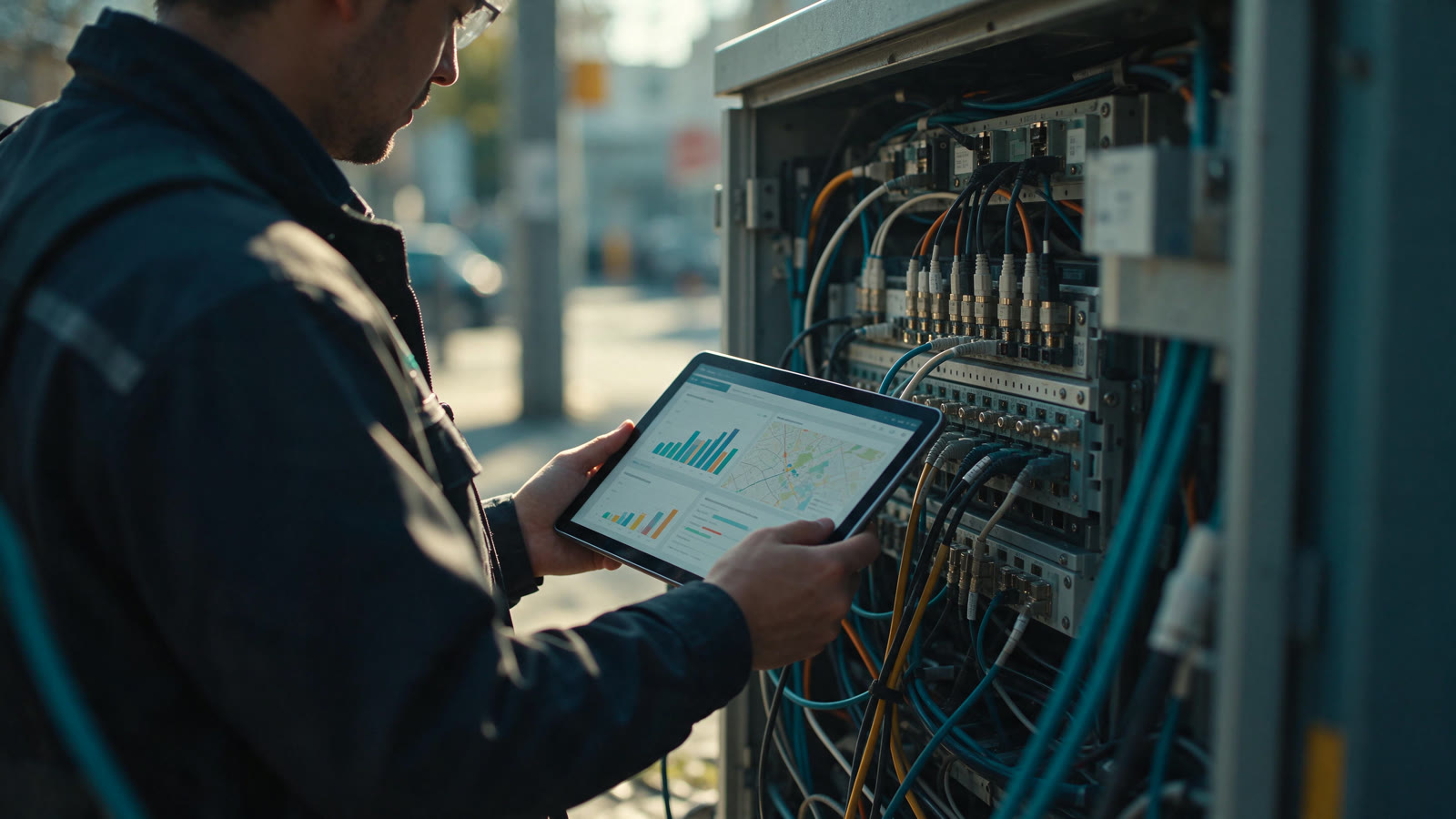
Inventory is a record of what the network should look like, updated by people after the work is done. When a repair, a move or a hurried install changes a port and the record does not follow, inventory offers capacity that no longer exists. Orders are accepted against it and fail at install, when a technician finds the port occupied. Every system upstream was correct according to the record, so the failure is logged as a visit that could not be completed.
- Inventory records what was planned. The port records what was done. Orders are sold on the first and installed on the second.
- The tell is live traffic on a port the inventory lists as free, and failed installs that cluster at the same cabinets.
- Every workaround in the field that is not written back creates the next failed install.
Two versions of the same cabinet
An infrastructure business holds its estate twice: once physically, as ports, fibres and panel positions, and once digitally, as inventory. Sales, order feasibility, port assignment and capacity planning all read the digital copy, because nobody can walk to a cabinet each time an order arrives.
The two copies are kept in step by people. A technician finishes a job, and the change is written into inventory from notes, by the technician or by someone else, at some point afterwards. That step is where the two copies part.
Suppose a fault takes down a customer on one port. The quickest repair is to move them to a spare port in the same cabinet, so the technician does that and service is restored. The ticket closes as resolved. The inventory still shows the customer on the original port, and the spare as free. Weeks later an order is accepted, the system assigns that spare port, and a visit is booked. The installer opens the cabinet and finds a live service on it.
Why nothing upstream looks wrong
- Inventory: capacity available, with a healthy utilisation figure.
- Order feasibility: passed, as it should on that record.
- The network: every live service working, including the one on the wrong port.
- The workforce system: a visit closed as unable to complete, under whichever reason code the installer chose.
- Capacity planning: headroom at that site, so no build is triggered.
A provisioning agent that assigns ports reads the same inventory and makes the same assignment faster. It did what it was built to do with the record it was given.
The reverse error sits beside it. A disconnection recorded in the order system but never released in inventory leaves a port marked in service with nothing on it. That is capacity you own, cannot see and may build again.
The records that disagree
- Inventory status by port: free, reserved or in service, and for which customer.
- Live port state from the network itself: link up, light received, traffic passing.
- Failed install tickets and installer notes, in the installer's own words: “port already in use”, “used next free port”.
- Fault tickets at the same cabinets, where a move during repair is the probable origin.
- Orders that were rescheduled or cancelled after a failed visit.
Inventory against live state gives the size of the gap. The tickets explain how each discrepancy got there.
An installer who finds the assigned port taken will try to finish the job on another free port. That is the right call for the customer in front of them. Unless that change is written back the same day, the record is now wrong in two places, and the port just used is offered to the next order.
What it costs, and how to size it
The unit of loss is failed orders and rework.
- Where the network reports live state, compare it with inventory port by port. Free in inventory but active is phantom capacity. In service in inventory but dark for months is stranded.
- Count installs that failed for want of a usable port over a period, and multiply by the cost of a repeat visit plus the time to reassign.
- For each, multiply the days between the planned and actual install by the daily recurring revenue, and count the orders cancelled in between.
- For passive plant with no live state, such as patch panels, audit a sample, starting with the cabinets that produced the most failed installs.
The first step also gives you a discrepancy rate for your own records, measured and not assumed.
Why it comes back
Records trail field work by design. During a repair the priority is restoring service, and it should be. Reconciliation, where it happens, is a periodic audit that is out of date soon after it finishes. Nothing compares the two copies continuously, so each discrepancy waits for an order to find it.
What fixes it
- Field operations: a job is not closed until the port actually used is recorded, at the cabinet.
- The inventory owner: compare inventory with live port state continuously, and hold disputed ports out of assignment until checked.
- Provisioning: check live state at the moment of assignment, not only the record.
- Capacity planning: restate utilisation once the discrepancies are counted.
- The provisioning agent: an eval case its next release must pass. Given a port that inventory lists as free and the network reports as active, it does not assign it and refers the conflict to a person.
Where Traxivo fits
Traxivo reads inventory records, the port state your network systems already collect, and install and fault tickets through read-only connections. Nothing is installed on a device, and no configuration or record is changed. It links a failed install to the earlier repair at the same cabinet as one issue with a history, recognises when a site keeps producing them, names the owners, and drafts the correction request for a named person to approve. See how Traxivo for Infrastructure finds phantom capacity, and the same pattern in other industries.
The ten use cases on the Traxivo for Infrastructure page are the ones most telecom, data centre and infrastructure estates share. Your niche will have failures of its own. We build custom solutions for those on top of the same platform: connectors for the feeds only your niche has, detection for the pattern only your estate shows, and the loss counted in your own unit. The same approach extends to niches such as colocation and interconnection, fibre and fixed wireless operators, managed network providers and edge and tower operators.
Sources
- IQGeo (press release carried by Cambridge Network). Only 13% of telecom operators say their network data is largely accurate, putting service activations and M&A at risk, 2026.
- IQGeo (press release carried by Cambridge Network). Only 13% of telecom operators say their network data is largely accurate, putting service activations and M&A at risk, 2026.
- Uptime Institute. Uptime Announces Annual Outage Analysis Report 2026, 2026.
Every figure on this page comes from the published source it is linked to and describes the industry at large. None is a Traxivo or customer result.
Frequently asked questions
What is phantom capacity in a network inventory?
Capacity the inventory lists as available that is in fact occupied. It arises when a physical change, such as a customer moved to a spare port during a repair, is never written back to the record. Orders accepted against that capacity fail when the installer reaches the port.
How can we measure how accurate our inventory is?
For active equipment, compare each port's inventory status with the live state the network reports. Ports that are free on record but active, or in service on record but dark, are discrepancies. For passive plant, audit a sample, starting where installs have failed.
Does Traxivo correct the inventory?
No. Traxivo is read-only and writes to no system. It links the conflicting records and tickets into one issue and drafts the correction request for a named person to approve. Your inventory owner makes the change.
Stop rediscovering the same integration failure
Traxivo links the alerts, tickets and email threads your teams already produce into one history per issue, recognises when a fault returns, and drafts the follow-up with the evidence attached. Nothing is sent until a person approves it.
See how Traxivo works See Traxivo for Infrastructure